


Baroque Pearl Jewelry
Baroque pearl jewelry is set with pearls that grew out of round, lobed, flattened or ridged, so no two baroque pearls are identical. The shape comes from nacre building up unevenly inside the mollusk. Freshwater pearls, cultured from a sliver of mantle tissue instead of a round bead, turn baroque more often than saltwater pearls, and a keshi pearl forms with no nucleus at all, so it is solid nacre. Every pearl on this page is cultured.
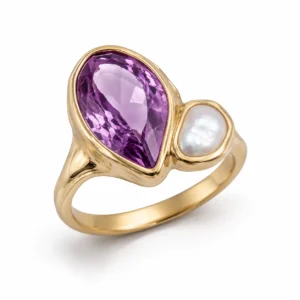
Since nature fixes the shape, the setting is built around the pearl. On a keshi pearl ring, for example, a deep hammered bezel follows the flat pearl’s uneven edge; on a cocktail ring, curls of gold-plated wire close loosely around a large pearl with pink and blue overtones, and a blue topaz cut as an emerald rests on top. A baroque pearl ring can also pair the pearl with a cut stone, as in a toi et moi of a pear-shaped amethyst and a small pearl. The pearl in the piece you receive will differ in outline from the one in the photo.
A baroque pearl necklace wears less formally than matched rounds, each pearl catching light at its own angle. One example strings cream-white freshwater pearls with round amethyst beads at uneven intervals.
With roundness out of the question, the grade of a baroque pearl rests on luster, surface and size, and these set its price more than the shape does. For pearls of every shape see pearl jewelry; how pearls are cultured and graded is in our pearl guide.
We couldn’t find a match
Try a different stone or material — you’ll see results instantly.
Collections evolve — new combinations appear regularly.
You may also like
Explore close matches — same category, different stone/material.
-
 Select US sizeQuick add This product has multiple variants. The options may be chosen on the product page
-
 Select US sizeQuick add This product has multiple variants. The options may be chosen on the product page
-
 Select US sizeQuick add This product has multiple variants. The options may be chosen on the product page


