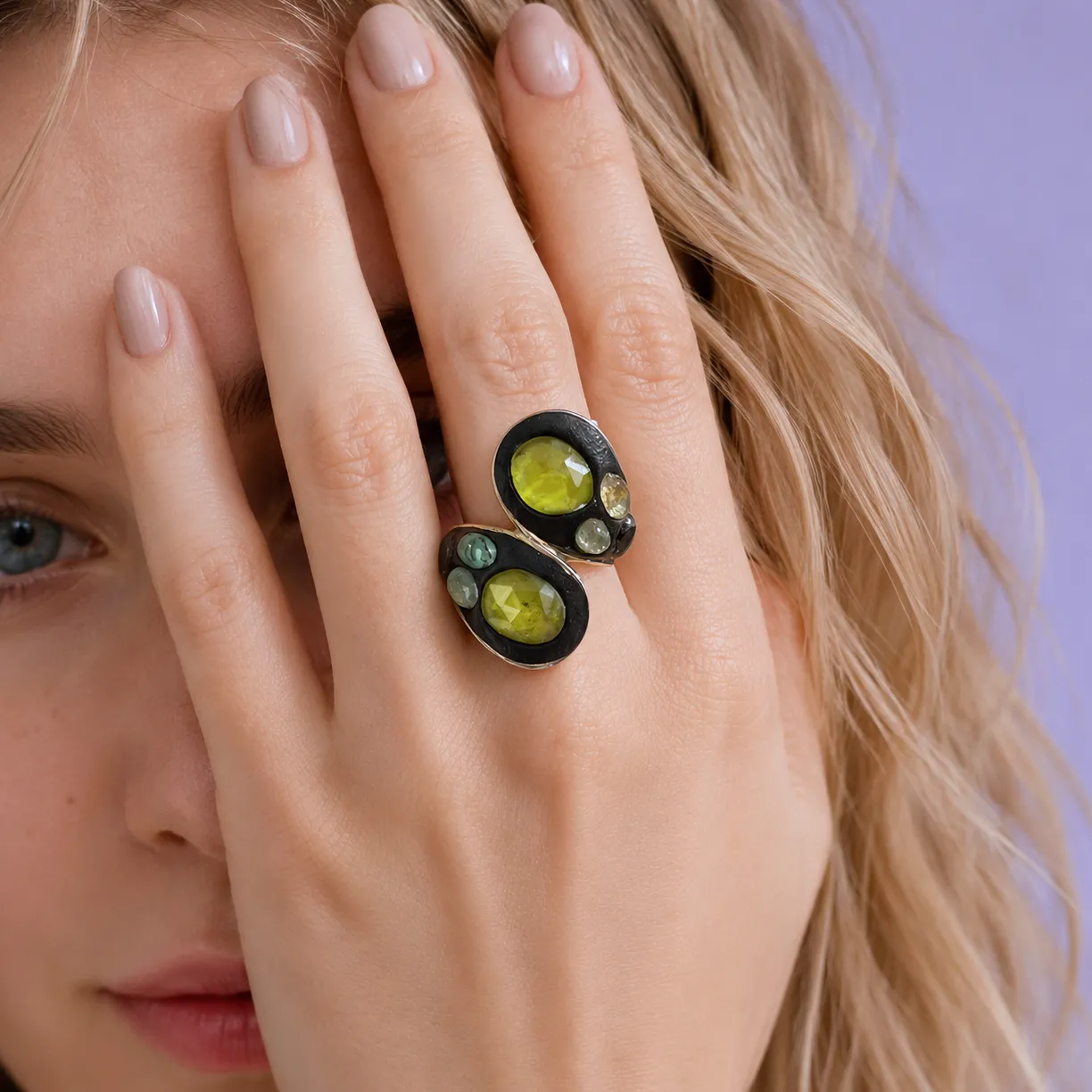


Bypass Rings
Bypass rings take their name from the band, whose two ends pass each other instead of joining, so the place where they overlap becomes the face of the ring. Each end can carry its own stone, which is why a bypass ring often shows two stones facing each other across the finger, the arrangement jewellers call toi et moi. When a gap stays between the passing ends, the ring is open as well, and such pieces also sit among our open rings.
The crossing is where each design does its work. In a 14K rose gold bypass ring, for example, a large cream South Sea pearl rests exactly where the ends cross, and two curving rows of natural tanzanite climb toward it from either side. A sterling silver bypass ring widens both ends into teardrop cups turned in opposite directions, each holding a rose cut natural peridot among smaller cabochons in a matte black ground. Other pieces take the idea further, such as a feather of oxidized silver whose tip curls past an oval lab-grown zultanite without touching it, or three gold coils that each end in a stone, cultured pearls and a lab-created sapphire.
Because the ends sit side by side, a bypass ring covers more of the finger than a single band. It works best worn alone, with plainer rings kept to the other hand. The raised ends can catch on knitwear and fine fabric, so check the stones and settings now and then. The bypass is one of several shapes among our unique rings.
We couldn’t find a match
Try a different stone or material — you’ll see results instantly.
Collections evolve — new combinations appear regularly.
You may also like
Explore close matches — same category, different stone/material.
-
 Select US sizeQuick add This product has multiple variants. The options may be chosen on the product page
-
 Select US sizeQuick add This product has multiple variants. The options may be chosen on the product page
-
 Select US sizeQuick add This product has multiple variants. The options may be chosen on the product page
-
 Select US sizeQuick add This product has multiple variants. The options may be chosen on the product page