

Open Rings
Open rings leave the band unclosed: its two ends stop short of each other or pass side by side, and the ring is designed around what happens at those ends. Every ring on this page has an open band. On a feather ring, for example, a single feather of oxidized sterling silver curls around the finger, and its tip passes beside an oval lab-grown zultanite in a gold-plated setting without touching it.
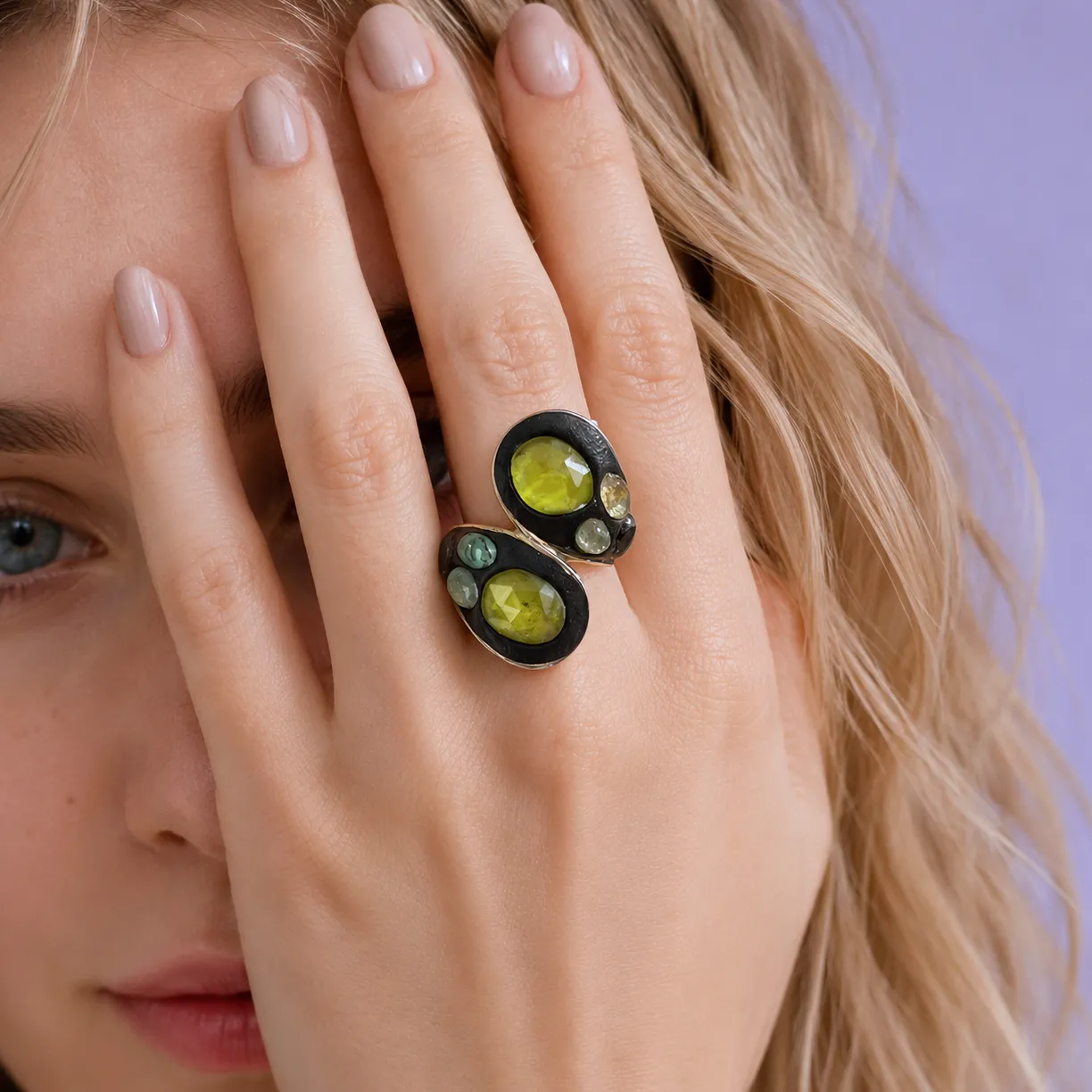
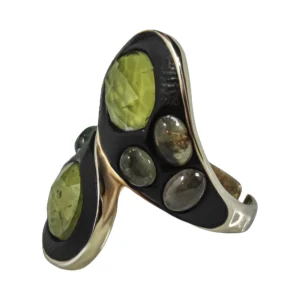
Other pieces use the opening for a crossing. In a 14K rose gold ring the ends cross beneath a large cream South Sea pearl, cultured and graded AAA, with two curving rows of natural tanzanites running up to it. In sterling silver, the two ends can swell into small cups that face away from each other, where a large peridot, natural and rose cut, shares a matte black bed with a few small cabochons inside a gold-plated rim. When the ends overlap like this, an open ring is also a bypass ring, and our bypass rings page collects that shape on its own.
Open rings are often sold as one-size adjustable bands. We do not describe ours that way: a ring offered in sizes, such as the feather or the peridot ring in US 3 to 11.5, is best ordered in your usual size. Squeezing or spreading an open band to change its fit bends the metal at the same point each time, which hardens silver and gold until they can crack and can loosen the setting around a stone. For more rings built around one design idea, see our unique rings.
We couldn’t find a match
Try a different stone or material — you’ll see results instantly.
Collections evolve — new combinations appear regularly.
You may also like
Explore close matches — same category, different stone/material.
-
 Select US sizeQuick add This product has multiple variants. The options may be chosen on the product page
-
 Select US sizeQuick add This product has multiple variants. The options may be chosen on the product page
-
 Select US sizeQuick add This product has multiple variants. The options may be chosen on the product page